Private team training + ongoing advisory
AI Engineering Enablement for Elixir Teams
Train your team to use AI without losing architectural control.
Groxio helps engineering teams build reliable Elixir systems with AI assistance without overloading senior reviewers, burying design decisions in prompts, or producing code that does not fit the organization.
Focused intensive
3-4 days of hands-on private team training
Real team workflow
PR size, review habits, rules, playbooks, and prompts
Follow-on advisory
Ongoing coaching around real PRs and architecture decisions
The problem
Your AI tools are faster than your team's current review and training system.
AI made code cheaper. It did not make judgment cheaper. The constraint is no longer how much code gets written. It is whether the code fits the system.
Pull requests get larger, less conversational, and harder to review.
Seniors become reviewers of tool output instead of designers of systems.
Existing patterns get duplicated under new names.
Managers see velocity rise while confidence quietly falls.
Architecture decisions get buried inside prompts, diffs, and local fixes.
Juniors are shipping more code, but not necessarily learning faster.
The problem is not simply bad AI code. It is a training gap.
Before AI, code was slow enough that many teams got reviewability and learning as side effects of the work. That constraint is gone. Teams now need to teach explicitly what used to be learned implicitly.
The goal
Build shared engineering judgment.
The training gives your team a common language for architecture, review, and AI-assisted delivery in real Elixir systems.
Model business domains clearly and design maintainable Elixir systems.
Use AI tools without surrendering design decisions.
Use Phoenix, LiveView, Ecto, Postgres, Ash, and OTP with stronger architectural judgment.
Produce smaller, clearer, more reviewable pull requests.
Recognize when AI-generated code fits the system and when it should be thrown away.
Work within team conventions that both humans and agents can follow.
What Groxio trains
AI-assisted engineering training grounded in Elixir system design.
AI-assisted engineering is the training frame, not an add-on. Teams practice the mental models, prompts, rules, review habits, and architecture decisions that let AI-assisted work fit real Elixir systems.
Elixir, OTP, and system mental models
- Process and message-passing model
- Supervision, fault tolerance, GenServer, and behaviour-based design
- Lifecycle boundaries, state, concurrency, and failure
- CRC: construct, reduce, convert
- Functional core vs boundary design
AI-assisted engineering workflow
- Architecture-first prompting
- Prompt layering with project rules and planning docs
- Repo-level rules, playbooks, and agent instructions
- Red and green indicators for AI output
- PR portion control, senior review, and self-review workflows
Phoenix and LiveView architecture
- Contexts and application boundaries
- Request flow and where business logic belongs
- LiveView lifecycle and state management
- Forms, components, streams, and real-time UI patterns
- Using AI to generate Phoenix and LiveView code without losing architecture
Data layer and domain model
- Postgres as the durable system of record
- Ecto schemas, migrations, changesets, queries, and transactions
- Validation boundaries and data integrity
- When logic belongs in the database, Ecto, Ash, or application layer
- Ash resources, actions, relationships, policies, and domain modeling
Engagement structure
Start focused. Continue only where the work creates value.
Private training is scoped by cohort size, duration, and follow-on advisory needs after a diagnostic conversation.
Start with a private intensive.
A focused 3-4 day training adapted to the team's current Elixir and AI experience, with hands-on exercises and shared mental models.
Continue with ongoing advisory when useful.
Regular 1-hour sessions can support senior and staff engineers around real PRs, architecture decisions, team conventions, and workflow refinements.
Expand only where the training creates clear value.
Repeat cohorts, senior deep dives, and targeted sessions on Ash, Phoenix, LiveView, OTP, review workflow, or AI-assisted delivery can follow.
First step
Talk with Bruce about your team.
The first step is a short diagnostic conversation. We look at your team's current Elixir experience, AI usage, review bottlenecks, and architecture concerns, then decide whether a private intensive plus ongoing advisory is the right fit.
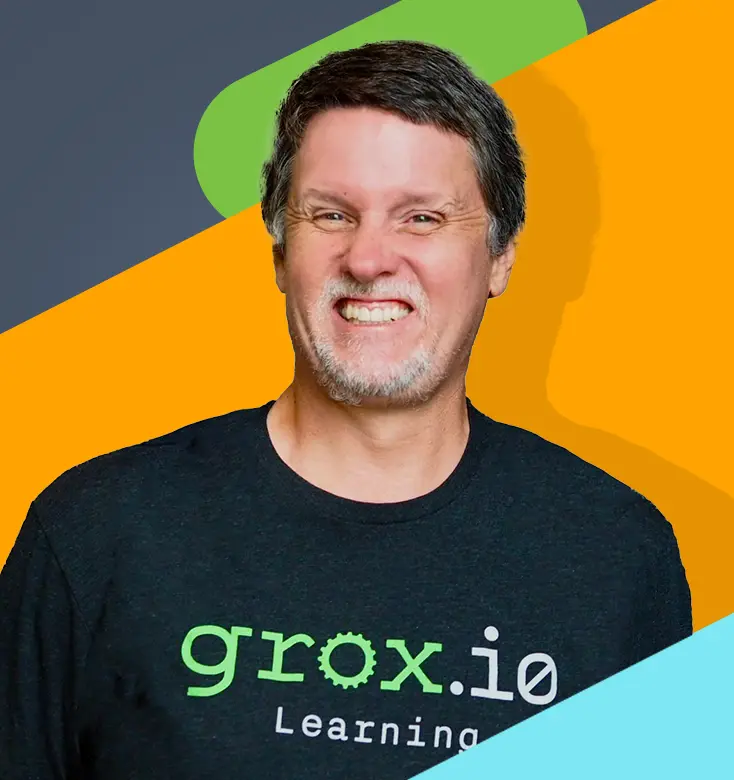
Bruce Tate
Author, educator, and Elixir system design coach
What AI tools are your engineers already using?
Where are review queues, senior attention, or architecture decisions getting stuck?
Which parts of the stack need the most help: OTP, Phoenix, LiveView, Ecto, Ash, Postgres, or workflow?